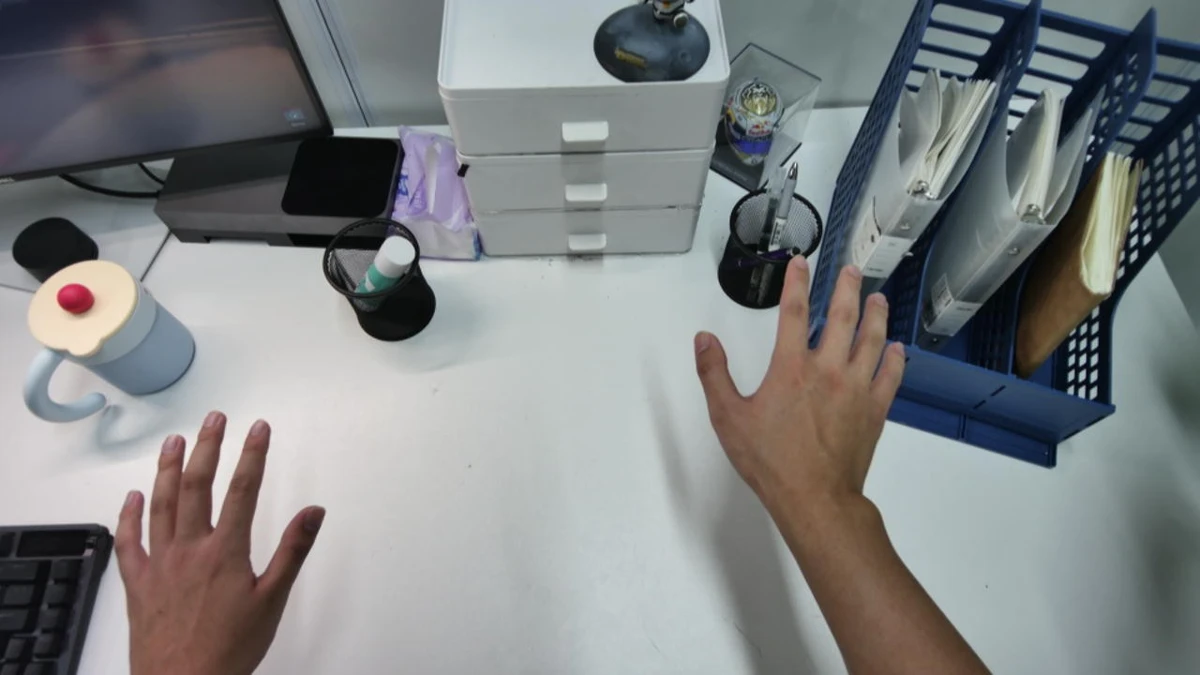
HumanWAM-Vanilla learns from egocentric video, language, and hand motion, then transfers that experience through robot post-training.
Study protocol and model architecture · Enlarge ↗
01
Learn from people
Video + language + hand motion
02
Adapt to robots
50 RoboTwin tasks 50 clean demonstrations per task
03
Test generalization
Clean · Scene-OOD · Random
02
More human experience. Better generalization.
More egocentric pretraining improves transfer to unfamiliar scenes under both isolated and inverse-dynamics attention.
Isolated attention
100 → 10,000 hours
Inverse-dynamics attention
100 → 50,000 hours
The clearest gains appear beyond the training scenes.
Evaluated after robot adaptation. Curves summarize the tested data ranges; each setting uses its best checkpoint.
03
Scale diversity, too.
Scale the range of tasks and scenes alongside hours of experience. Growing coverage produces steeper gains than adding trajectories within fixed coverage.
What changes as we scale?
Two corpus families, one shared 5,000-hour parent.
Family
Hours
Clips
Tasks
Scenes
Scaled-diversity
100
62,206
62
222
500
305,889
309
961
1,000
589,216
547
1,442
Coverage-matched
100
81,076
2,288
2,953
500
345,053
2,288
2,953
1,000
653,567
2,288
2,953
Shared parent
5,000
2,813,547
2,288
2,953
Coverage-matched keeps task and scene coverage fixed; it is labeled “Matched-diversity” in the plot.
Diverse experience produces steeper gains
Same robot post-training protocol · Enlarge ↗
More tasks. More scenes. Stronger transfer.
Explore robot-data efficiencyRobot demonstrations needed after adaptation.
02 / HumanWAM-Goal
Toward an out-of-the-box action executor.
Human + robot data
+
Language + visual goal
→
Robot actions
Explore the shared action space 49D
Model / HumanWAM-Goal
A visual goal connects experience to execution.
Goal-conditioned joint video and action generation · Enlarge ↗
Simulation / RoboTwin · ALOHA-AgileX
Leading zero-shot performance. Leading after post-training.
Evaluate the pretrained checkpoint directly, then evaluate after RoboTwin post-training. The protocols are distinct; both measure average success across Clean and Random.
Before task post-trainingRank 1
Open-source zero-shot
13.94%Average success
Rank 1 among successfully evaluated open-source checkpoints.
Select the figure to enlarge ↗
Human data: 11.48% → 13.94%. No task post-training · Table 12.
After task post-trainingRank 1
RoboTwin post-trained
88.65%Average success
Rank 1 in the reported RoboTwin post-training comparison.
Positioning excerpts from the pretrained policy. In B, the bottle tips after release in the source recording.
04 / Real robot · Goal-guided ICL
Keep the policy. Change the goal.
Same policy. Different visual targets.
After task post-training
05 / Real robot · Cross-embodiment goal conditioning
Human goal images guide robot execution.
A human-view goal directs the robot after task post-training.
After task post-training
06 / Real robot · Long-horizon execution
From a single placement to long-horizon tasks.
After task-specific post-training, HumanWAM-Goal chains 14 desk-organization stages and performs mobile household tidying across multiple work areas on Astribot S1.
After task-specific post-training
A desk, progressively organized.
Mug placement, stationery collection, drawer storage, and notebook arrangement in one recorded sequence.
Cup→Stationery→Drawers→Books
Selected qualitative recordings.
And, before you go…
One more thing.
A human demonstrates. The robot follows.
A person demonstrates an interaction; the robot then follows in the same continuous recording. The policy remains in inference throughout, with no mode switch between demonstration and execution.
Continuous recordings · automatic loops
01 / Human demonstration → Robot responseContinuous take02 / Human demonstration → Robot responseContinuous take
Explore the research
Open-HumanScale
Read the paper and explore the code. Model checkpoints and dataset links are coming soon.
BibTeX +
@misc{ma2026openhumanscale,
  title = {Open-HumanScale: An Open Recipe for Scaling Human
    and Robot Experience for Embodied Foundation Model},
  author = {Ma, Juncheng and Li, Jiaxin and Tu, Jiankai and
    Liang, Bo and Lv, Guodong and Deng, Yufan and
    Tang, Junzhe and Yang, Liangzhu and Bian, Chen and
    Cao, Zicong and Zhu, Baohao and Bi, Jianxin and
    Yan, Tengfei and Zhang, Yinyuan and Zhang, Kewei and
    Chen, Xinglong and Chen, Kaiqi and Wang, Duomin and
    Tang, Xiaotian and Li, Li and Xu, Yuan and
    Yang, Haosen and Wang, Yuqi and Xia, Jingfei and
    Huang, Eric and Dou, Zhiyang and Dong, Zhen and
    Xie, Enze and Chua, Tat-Seng and
    Zhou, Daquan},
  year = {2026},
  eprint = {2611.06817},
  archivePrefix = {arXiv},
  url = {https://arxiv.org/abs/2611.06817}
}