Rethinking World-Action Model for
Compositional and In-Context Robotic Manipulation
ViGAR — Visual Goal-conditioned Action Reasoning


Overview video
RoboTwin 2.0 Leaderboard
Simulation · RoboTwin Clean2Random
average success rate (%) over the Clean and Random settings · 50 tasks × 100 rollouts eachReal robot · AgiBot A2
average task progress over 5 long-horizon tasks × 20 rolloutsReal-robot Demos
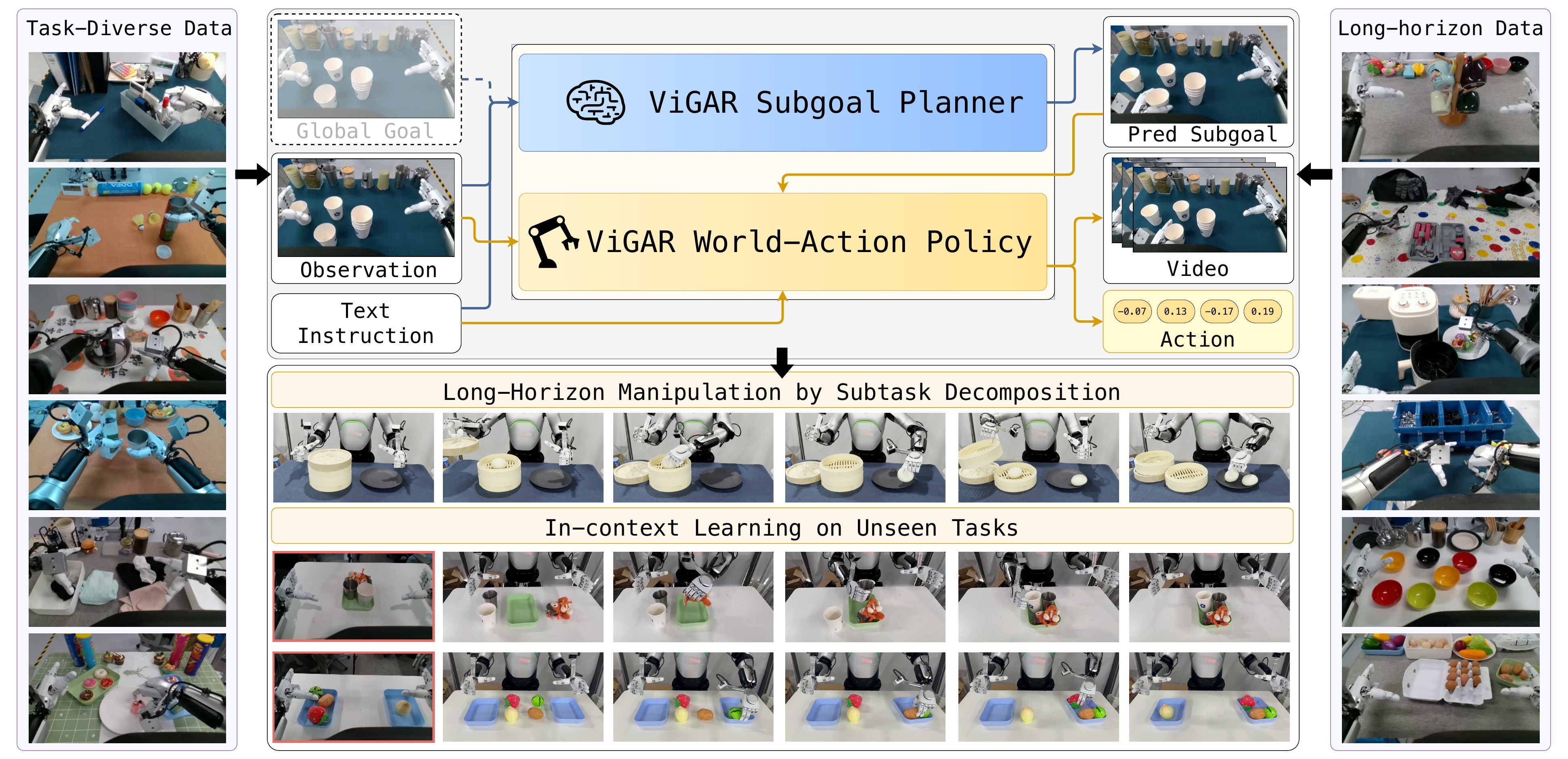
Compositional manipulation
In-context manipulation from a global goal image
Each tile shows the global goal handed to the planner (blue) next to the resulting rollout (red).
About ViGAR
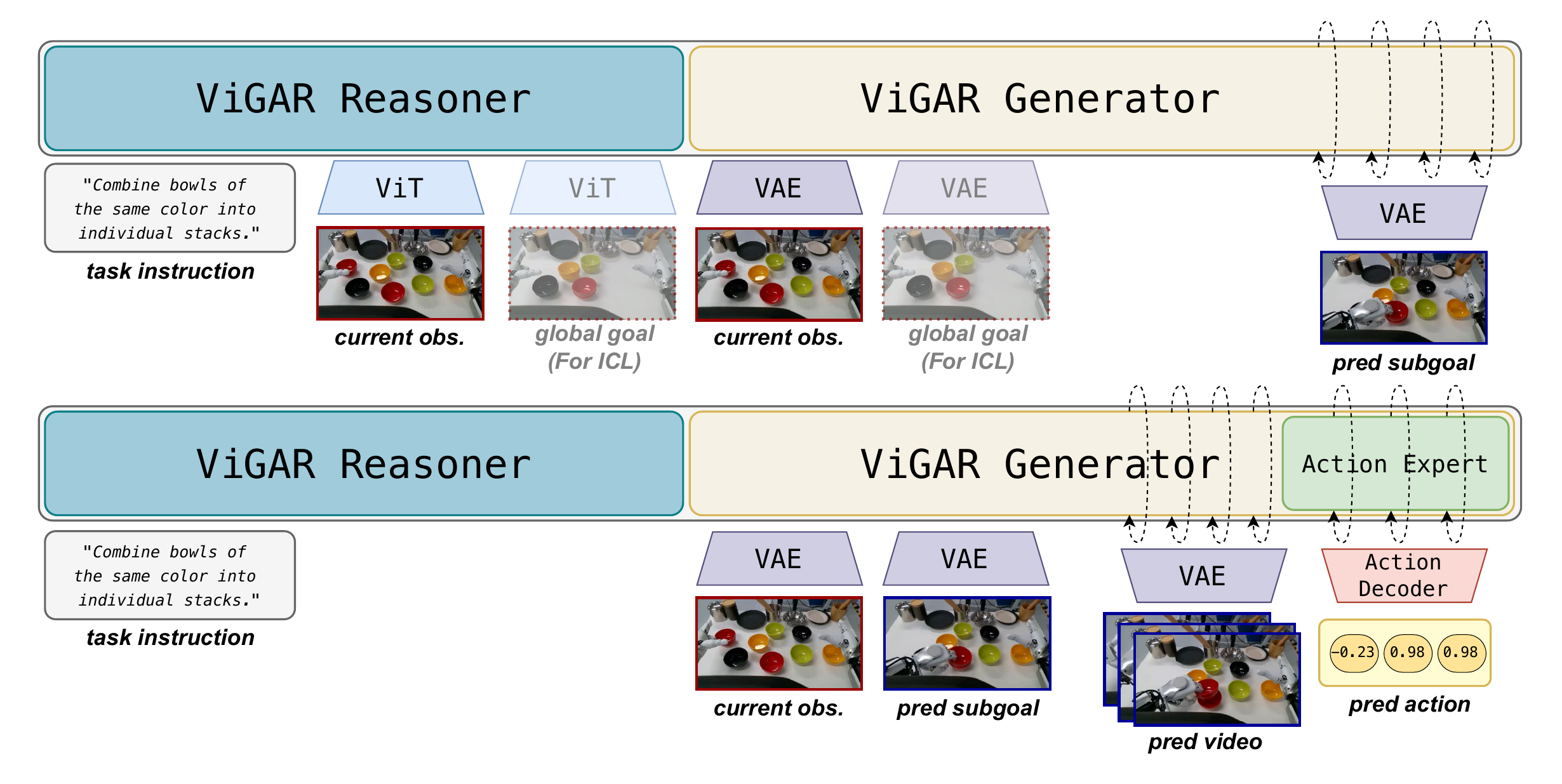
Model architecture. (1) The subgoal planner Gθ generates the next subgoal image from the task instruction and current observation, optionally conditioned on a global goal image for in-context learning. (2) The policy πWAMφ takes the predicted subgoal and jointly predicts the future frames and the action chunk. Both share the Cosmos3-Nano reasoner–generator backbone.
Long-horizon compositional manipulation has become increasingly important for real-world robot deployment, where a single task involves multiple coordinated subtasks. Existing world-action models (WAMs) jointly predict short-horizon visual futures and actions, but typically lack explicit subtask-level reasoning. We propose Visual Goal-conditioned Action Reasoning (ViGAR), a hierarchical framework that factorizes manipulation into a visual subgoal planner and a subgoal executor. Given the current observation and global instruction, the subgoal planner predicts a visual subgoal for the next subtask. The subgoal executor then jointly generates future visual trajectories and actions conditioned on the predicted subgoal. Both components share a pretrained world-model representation, enabling task-level planning and action generation to benefit from common physical knowledge.
Moreover, our framework naturally supports in-context learning: using a global goal image as context can induce different subtask decompositions and behaviors without parameter updates. On the RoboTwin Clean2Random benchmark, ViGAR achieves 82.00% and 67.02% success rates under the Clean and Random settings, surpassing the strongest baseline by 12.81% in average success rate. Real-world robot experiments on five compositional and two in-context learning tasks further confirm the effectiveness of ViGAR.
Making subgoal supervision consistent
Two implementation choices matter for training the planner. Frames at the end of subtask i look almost identical to frames at the start of subtask i+1, yet the naive labels send them to different targets, so a planner tends to regress to a subtask that is already done. And most pixels in a subgoal are static background, so a plain reconstruction loss under-weights the region where manipulation actually happens.
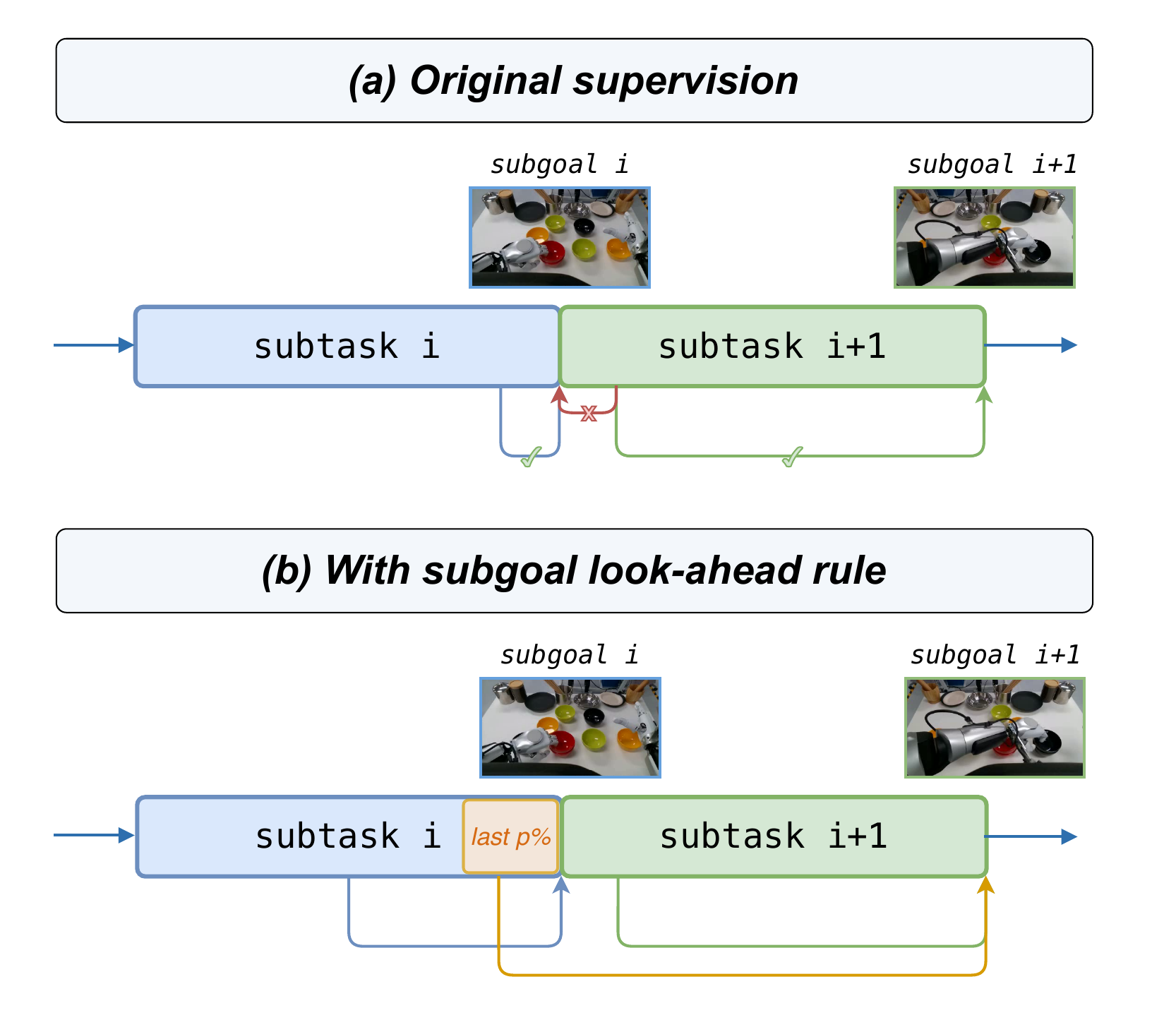
Subgoal look-ahead rule. Observations in the last p% of subtask Ti are re-targeted to gi+1, so visually similar inputs across the boundary receive consistent supervision.
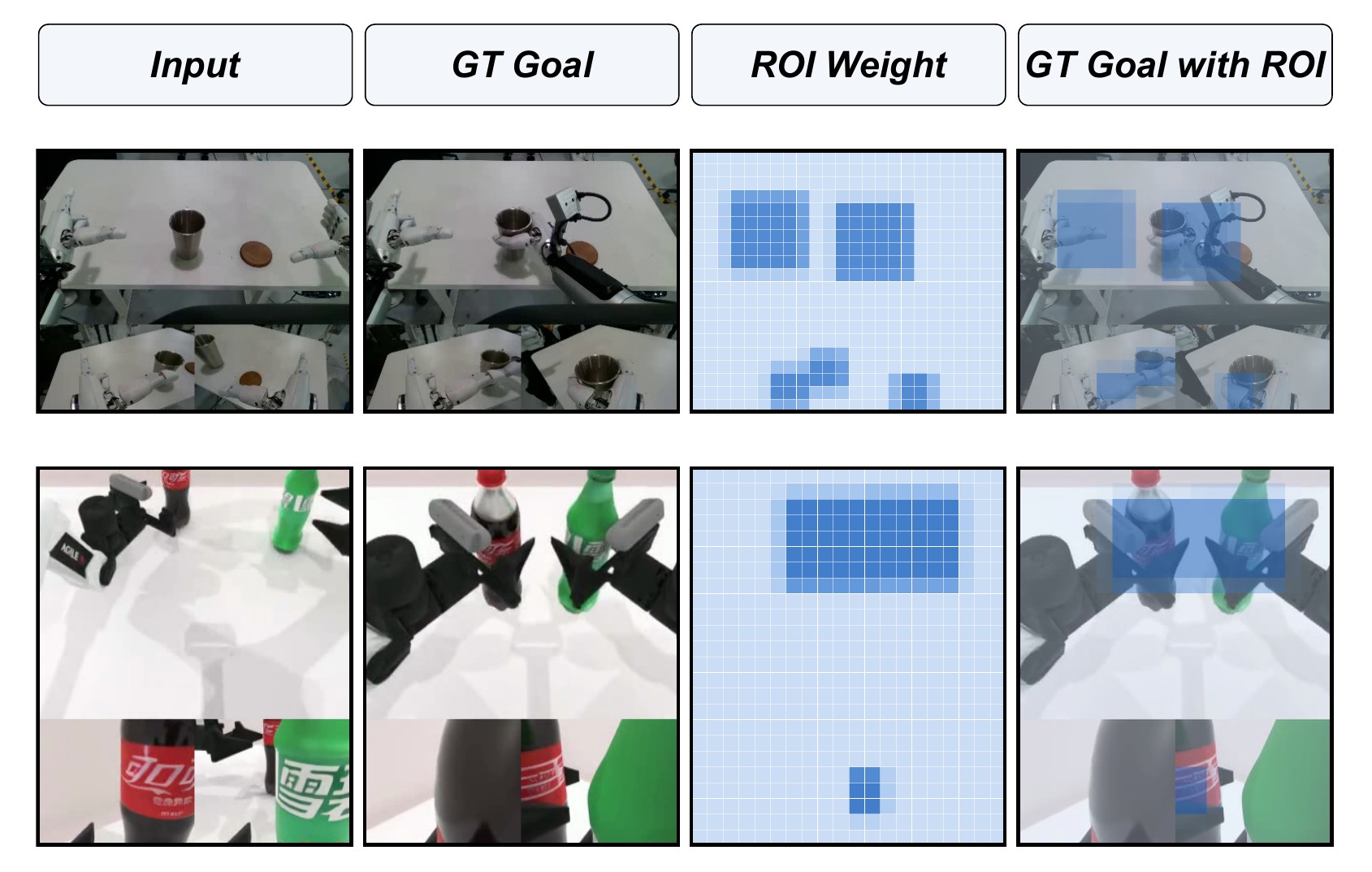
End-effector ROI weighting. Expert end-effector positions are projected through the calibrated cameras; the flow-matching loss is re-weighted 4:1 toward the union of windows around them.
Ablation: subgoal supervision
RoboTwin avg. success (%)Ablation: goal injection route
RoboTwin avg. success (%), ground-truth goals, 30k stepsRoboTwin Clean2Random
50 bimanual tasks on the Aloha AgileX embodiment, multi-task training on 2,500 Clean expert demonstrations, 100 rollouts per task under Clean and Random conditions. Clean is nearly saturated across WAMs; the benefit of explicit subgoal selection shows up exactly when the layout can no longer be memorized from demonstrations.
+21.0 pts over the best baseline under Random
RoboTwin Clean2Random, Random success rate (%) (↑)
Policy success rate (%)
| Model | Clean | Random | Avg. |
|---|---|---|---|
| Vision-language-action policies | |||
| StarVLA | 46.50 | 3.20 | 24.90 |
| Abot-M0 | 57.40 | 30.40 | 43.90 |
| X-VLA | 68.00 | 20.90 | 44.50 |
| π0.5 | 70.70 | 46.00 | 58.40 |
| World-action models | |||
| FastWAM | 77.80 | 1.90 | 39.90 |
| LingbotVA | 80.70 | 34.60 | 57.70 |
| 4D-WAM | 81.50 | 41.80 | 61.70 |
| Cosmos3-Nano-RoboTwin same recipe, no subgoal | 77.06 | 22.46 | 49.76 |
| ViGAR | 82.00 | 67.02 | 74.51 |
Visual subgoal prediction quality
| Model | LPIPS ↓ | DINO-cos ↑ | ΔIoU ↑ | RetAcc ↑ |
|---|---|---|---|---|
| RoboTwin | ||||
| VISTA | 0.38 | 0.54 | 0.22 | 0.82 |
| RxBrain | 0.73 | 0.19 | 0.18 | 0.79 |
| ViGAR Gθ | 0.13 | 0.80 | 0.65 | 0.94 |
| Real robot | ||||
| VISTA | 0.38 | 0.61 | 0.24 | 0.31 |
| RxBrain | 0.60 | 0.29 | 0.18 | 0.22 |
| ViGAR Gθ | 0.11 | 0.81 | 0.66 | 0.76 |
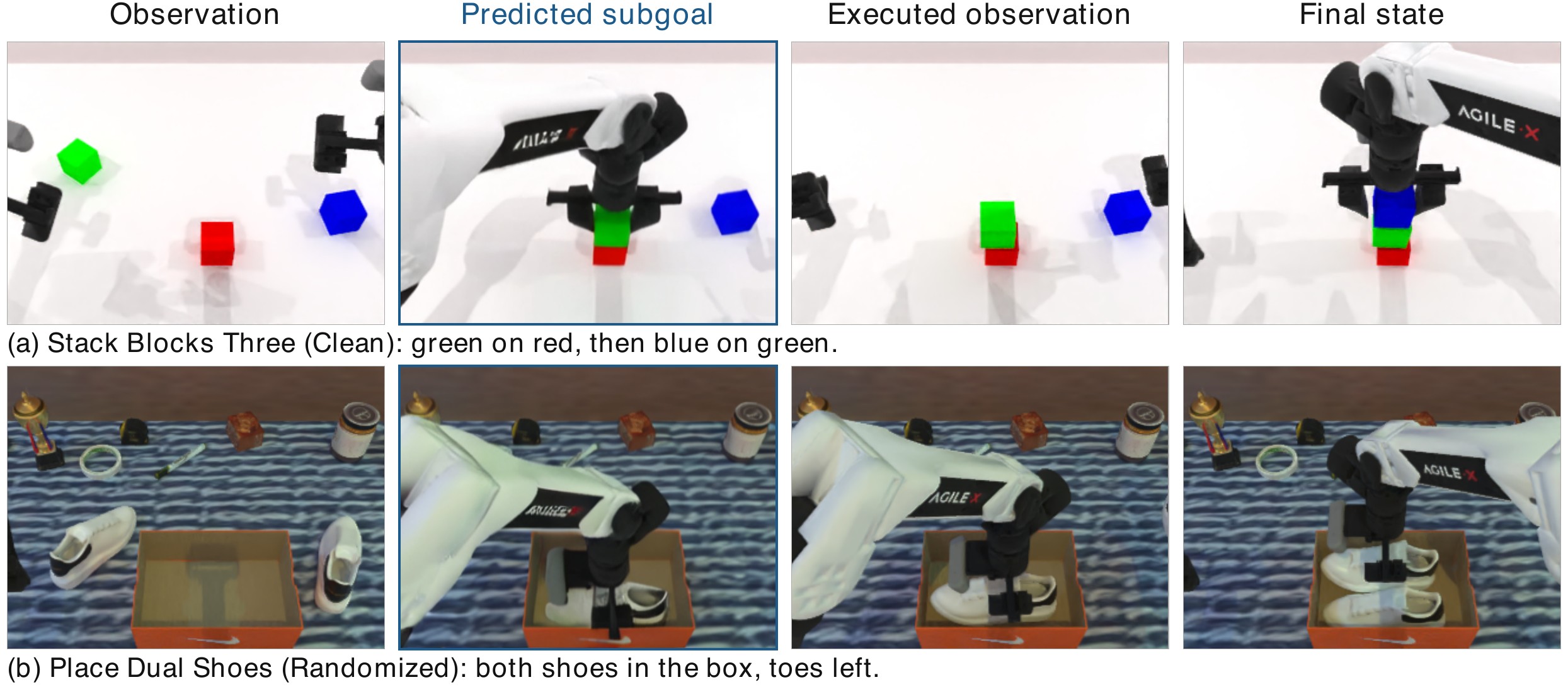
Simulation rollouts. Observation → predicted subgoal → executed observation → final state, for Stack Blocks Three (Clean) and Place Dual Shoes (Randomized).
Real-robot compositional manipulation
Experiments run on an AgiBot A2 with two 7-DoF arms, two wrist cameras and one front-facing camera. ViGAR is mid-trained on ∼900 hours of teleoperation data from the same embodiment (752 tasks, 200+ objects, 10+ backgrounds), then post-trained on task-specific demonstrations. Five long-horizon tasks are evaluated over 20 rollouts each and scored by task progress (fraction of sequential stages completed).
In-context manipulation from a global goal image
With the initial scene and the language instruction held fixed, only a global goal image G is handed to the subgoal planner. Training demonstrations cover a restricted set of placement patterns; at test time an unseen goal specifies a task composition that was never demonstrated, and the planner decomposes it into subgoals that the unchanged policy executes.
Task progress over 20 rollouts each. OOD averages combine two unseen goal configurations with different numbers of stages.
BibTeX
@article{gong2026rethinking,
  title={Rethinking World-Action Model for Compositional and In-Context Robotic Manipulation},
  author={Gong, Shukai and Zhai, Xuanran and Zhang, Yintianrun and Cui, Ruopeng and Huang, Ye and Fu, Yiyang and Lyu, Dexuan and Li, Chaojie and Song, Xinyi and Lin, Peiwen and others},
  journal={arXiv preprint arXiv:2610.02368},
  year={2026}
}